Your phone drops to 5%, and there isn’t a socket anywhere. A power bank for phones solves that in a few minutes. It’s a small rechargeable battery that lives in your bag or pocket, so a dead phone doesn’t wreck your day. In this guide, I’ll walk you through the types, capacities, and features, so you can find the best power bank for phones without overspending. Whether you need a portable phone charger for the daily commute or a long trip, there’s something here for you. If you’d like to see a real example, the Kratos PB03 MagSafe power bank packs 10,000mAh with wireless and fast charging.
What Is a Power Bank for Phones?
A power bank keeps electricity stored in its own battery. When your phone runs low, you plug it in with a cable, and the stored power flows across. That’s really all a portable phone charger does. Think of it as phone battery backup you can toss in a bag. If you spend the day on maps, music, video calls, and social media, a power bank for smartphones means you won’t be hunting for outlets.
Different Types of Power Banks
Here are the different types of power banks
- Standard Power Banks
These are simple, dependable, and usually the cheapest. You plug in a cable and charge. They work well if all you want is basic phone battery backup with no frills.
- Fast Charging Power Banks
A fast-charging power bank gets your phone from low to usable much quicker, as long as your phone supports fast charging too.
- Wireless Power Banks
A wireless power bank for phones lets you just rest your phone on top. No cable needed. It’s neat, but it’s usually slower than wired charging.
- Magnetic Power Banks
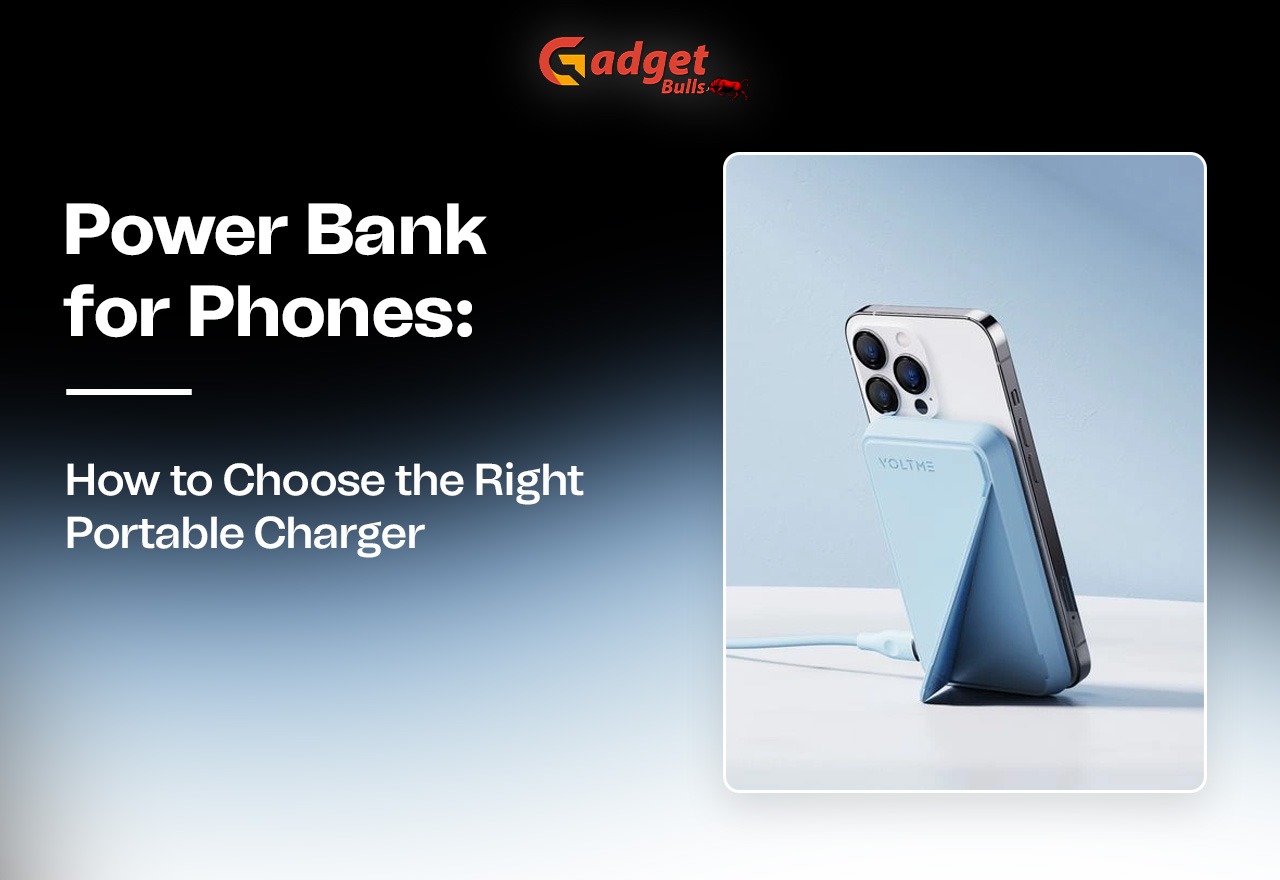
These snap onto the back of compatible phones, so there’s no cable and nothing to hold.
- Compact and Mini Power Banks
They’re small enough to fit in a jeans pocket. They hold less power, but they’re easy to carry everywhere.
How to Choose the Right Capacity
To find the best portable power bank, you should know about the right capacity of the power bank
- 5,000mAh for Basic Charging- You get roughly one full charge, which is fine for light use and short outings.
- 10,000mAh for Everyday Use- A 10000mAh power bank is the sweet spot for most people. It gives you about two charges and still slips easily into a bag.
- 20,000mAh for Multiple Charges- A 20000mAh power bank can charge a phone around three to four times, so it suits travel or sharing with a friend. The catch is that it’s heavier.
High-Capacity for Heavy Users
Gamers, creators, and frequent long-distance travellers may want even more. If you’re a gamer, these mobile gaming accessories pair well with a big power bank. If you’re flying, check the airline’s rules before you pack a big one. One thing to remember: what you actually get is always a bit less than the number on the box, because some energy is lost while charging.
Features to Check Before Buying a Power Bank for Phones
- Charging speed and wattage: Higher wattage means faster top-ups, if your phone can take it.
- USB-C and USB-A ports: A USB-C power bank is a smart pick, since most new phones use USB-C.
- Fast charging compatibility: Match it to the standard your phone supports.
- Battery protection: Look for overheating and overcharge protection.
- Size and weight: If it’s too heavy, you’ll end up leaving it at home.
- Multiple device charging: Handy if you also carry earbuds or a watch.
Wired vs Wireless Power Bank for Phones: Which Is Better?
It really depends on how you use your phone. Here’s a quick breakdown.
Advantages of Wired Charging
Wired charging is faster and wastes less energy. If you’re running late and need a quick top-up, a fast-charging power bank with a cable is the better pick.
Benefits of Wireless Charging
A wireless power bank for phones is more convenient because there’s no cable to fumble with. You just rest your phone on it. The downside is that it’s slower and loses more energy along the way.
Which Option Should You Choose?
If you’re always rushing, go wired. If you like things easy and don’t mind waiting a little, wireless is a nice bonus. Plenty of people carry a wired power bank for phones for emergencies and use wireless at their desk.
How to Check Whether a Power Bank Is Compatible with Your Phone
A power bank that doesn’t match your phone is just dead weight, so a quick check before buying saves a lot of hassle:
- Check your phone’s charging port. Most new phones use USB-C, so a USB-C power bank is usually a safe match.
- Find the charging standards it supports. Your phone’s manual or spec sheet will tell you.
- Compare voltage and wattage. The power bank should be able to give what your phone asks for.
- Confirm wireless support. Do this only if you want wireless charging.
Don’t forget the cable either. It counts as one of your mobile charging accessories, and a weak one can slow everything down, even with a great power bank.
Benefits of Using a Power Bank for Phones
Here’s why so many people carry one:
- Easy charging while travelling. No more hunting for a socket on trains, flights, or road trips.
- Extra battery on busy days. Your phone keeps going through long days of calls, maps and messages.
- Useful on hikes and outdoor trips. Handy when there’s no electricity for miles.
- Less reliance on wall outlets. You can charge wherever you are.
Common Mistakes to Avoid When Buying a Phone Power Bank
A few slip-ups are easy to avoid:
- Choosing by capacity alone. Charging speed matters just as much.
- Buying cheap, unbranded models. They often skip safety protection.
- Using a poor cable. Pairing it with a weak cable from your mobile charging accessories slows charging.
- Ignoring weight and size. If it’s too bulky, you’ll leave it at home.
Tips to Maintain Your Power Bank for Better Performance
A little care helps your power bank last for years:
- Keep it away from heat. Don’t leave it in a hot car or in direct sun.
- Try not to drop it. Knocks can damage the battery inside.
- Recharge it now and then. Do this even when you’re not using it.
- Use a good cable. It protects both the power bank and your phone. For more ideas, see these must-have mobile phone accessories for everyday use.
- Don’t leave it plugged in for days. Unplug it once it’s full.
Final Thoughts
Picking a power bank for phones doesn’t need to be complicated. Think about how you use your phone, then match the capacity, charging speed, and ports to that. A 10,000mAh USB-C model with fast charging works for most people, while heavy users or frequent travellers may prefer something bigger. Skip the cheap, unbranded options, pair it with a good cable and look after it, and it will keep your phone alive for years. Take a few minutes to compare, pick one you’ll actually carry, and you can stop worrying about that 5% warning. Shopping for someone else? A power bank also makes a handy present, so have a look at these best tech gifts for women in 2026.
FAQs
- Which power bank is best for phones?
A 10,000mAh power bank is ideal for everyday smartphone charging, while a 20,000mAh model suits users who need extra battery backup. Choose one with fast charging, USB-C support, and safety protection.
- Is a 10,000mAh power bank enough for a smartphone?
Yes, a 10,000mAh power bank is generally sufficient for everyday smartphone use. It can provide approximately one to two charges, depending on battery capacity and charging efficiency.
- How many times can a 20,000mAh power bank charge a phone?
A 20,000mAh power bank can typically charge a smartphone around three to four times. The actual number depends on battery size and energy conversion losses.
- Is a fast charging power bank safe for phones?
Yes, a fast-charging power bank is safe when it supports your phone’s charging standards. Choose a reliable model with overheating, overcurrent, and overcharge protection.
- Can I use a power bank while using my phone?
Yes, you can use your phone while it is connected to a power bank. However, avoid demanding activities that generate excessive heat during charging.